Will AI Take Your Job Before You Even Get One? Here’s the Truth.
AI’s Impact on Jobs: The Shift from Fear to Opportunity
First, a Quick Reality Check
Before getting into the story, let me remind you of something.
When computers first became a thing, people were scared. They thought it would take away all the jobs. And yes, it did replace some—like the clerk who used only pen and paper. But fast forward to today, and look around: computers have created way more jobs than they replaced. That same clerk? He probably learned how to use Excel and got even better at his job.
Now, here we are again. Same fear, new tech. This time, it’s AI.
So... Is AI Going to Steal Our Jobs?

Let’s be real. This is the question almost every tech student is thinking about lately.
With headlines shouting about layoffs at Google, Microsoft, Meta, Apple, TCS, and more, it’s hard not to stress.
A report by Goldman Sachs even estimates that 300 million jobs could be displaced globally by 2030.
And already, 25% of routine tasks are being automated.
According to Statista, 46% of office/admin work is highly vulnerable to AI.
Sounds intense, right?
On top of that, AI can already automate 70% of workforce tasks, says McKinsey.
And 23% of existing roles are expected to change completely by 2027.
If you’re aiming for an entry-level job, it’s natural to feel nervous. That’s where the pressure hits first.
But Hold On — It’s Not All Doom and Gloom

Before we spiral into panic, here’s the flip side: AI is also creating jobs. A lot of them.
In fact, a recent survey suggests that 170 million new jobs will pop up globally this decade, even while AI is automating so many other roles. And guess what? 69 million new positions will emerge, even as 92 million disappear – so that’s a net gain of 14 million jobs in the next five years. Seems like there’s still hope, right?
So yeah, AI will change the game—but it doesn’t mean we’re out of the game.
The Real Gamechanger: People Who Know AI
It’s not about competing against AI—it’s about working with it.
Magnus Grimeland, venture capitalist and founder of Antler, said:
“The demand for great software engineers will only increase in the coming decades.”
Why? Because even the smartest AI can mess up. That’s where you come in—to clean up, guide, and make better decisions. It still needs us humans to fix things.
Mark Zuckerberg, CEO of Meta, put it this way:
“AI allows small startups to do what only large teams could do before.”
That’s huge. With just a small team and the right AI tools, you can launch products that once needed full departments.
Even big companies are taking note. JP Morgan is training 200,000+ employees on AI tools because they see AI as a must-have skill, not a fancy add-on.
And guess what?
70% of companies are expected to be using AI by 2030.
Not knowing how to use it might be the new “not knowing how to use email.”
It’s Not AI vs You — It’s AI with You

This might be the most important line in this whole article:
It’s not AI vs YOU — it’s AI + YOU.
Instead of being scared, look at AI like your teammate. It can handle all the boring, repeat work, and leave you with the creative, strategic stuff.
Jensen Huang, CEO of NVIDIA, put it perfectly:
“You won’t lose your job to AI, but to someone who uses it.”
And Bill Gates backed that up too. He said:
“AI will free us up to do things that software never helped with before—like teaching, caring for patients, and supporting the elderly.”
So basically, AI isn’t stealing your future. It’s reshaping it.
Heard About Vibe Coding?

Let’s take a quick detour to talk about something buzzing in the dev world lately: vibe coding (or vibecoding).
No, it’s not a programming language—it’s more of a mindset and approach.
It’s like coding based on your gut, your flow—the vibe of the project. You don’t overthink every line. You just start building. It's about being experimental and going with what feels right.
But here's the twist...
According to Wikipedia, vibe coding also refers to a new AI-driven way of programming, where you describe your problem in natural language (like a prompt), and a large language model (LLM) like ChatGPT writes the code for you.
The term was introduced by Andrej Karpathy (former OpenAI co-founder and Tesla AI lead) in February 2025, who said:
“It’s not really coding — I just see things, say things, run things, and copy-paste things, and it mostly works.”
He uses this method for weekend projects, calling it “conversational coding” — using voice prompts and letting AI do the typing.
Now, vibe coding isn’t perfect. Yeah, it can get messy. Bugs can creep in. And in big projects, things can break. But for small hacks, MVPs, or personal stuff? It helps you stay in the zone and avoid burnout.
So whether you’re vibing with your keyboard or vibing with an AI, next time you’re stuck, don’t overthink it — just vibe code it.
What You Can Actually Do About All This
Alright, so what now?
Here’s how you future-proof yourself in the age of AI:
Learn AI tools – Not just ChatGPT, but tools that fit your field.
Build hybrid skills – Pair your tech knowledge with creativity, communication, and problem-solving.
Stay curious and open-minded – Like Anima Anandkumar, Director of ML at NVIDIA, says:
“Don’t fear AI. Focus on the things AI can’t do—like solving new, hard problems.”
Most importantly: don’t just follow trends. Adapt to them.
Marketing, customer support, analytics—all being reshaped by AI.
But fields that need human judgment—like design, writing, education, or mental health—are still super relevant.
TL;DR – The Future of Jobs Is Still Yours
AI’s not here to destroy us. It’s here to change how we work.
So here’s what you need to ask yourself:
Will you let AI handle the repetitive stuff while you level up?
Will you use it to build smarter, faster, and more creatively?
Will you adapt—or be replaced by someone who does?
Because in the end, the future of work won’t be written by AI.
It’ll be written by people who know how to use it.
So next time someone says, “Will AI take your job?”
You say:
“Only if I ignore it.”
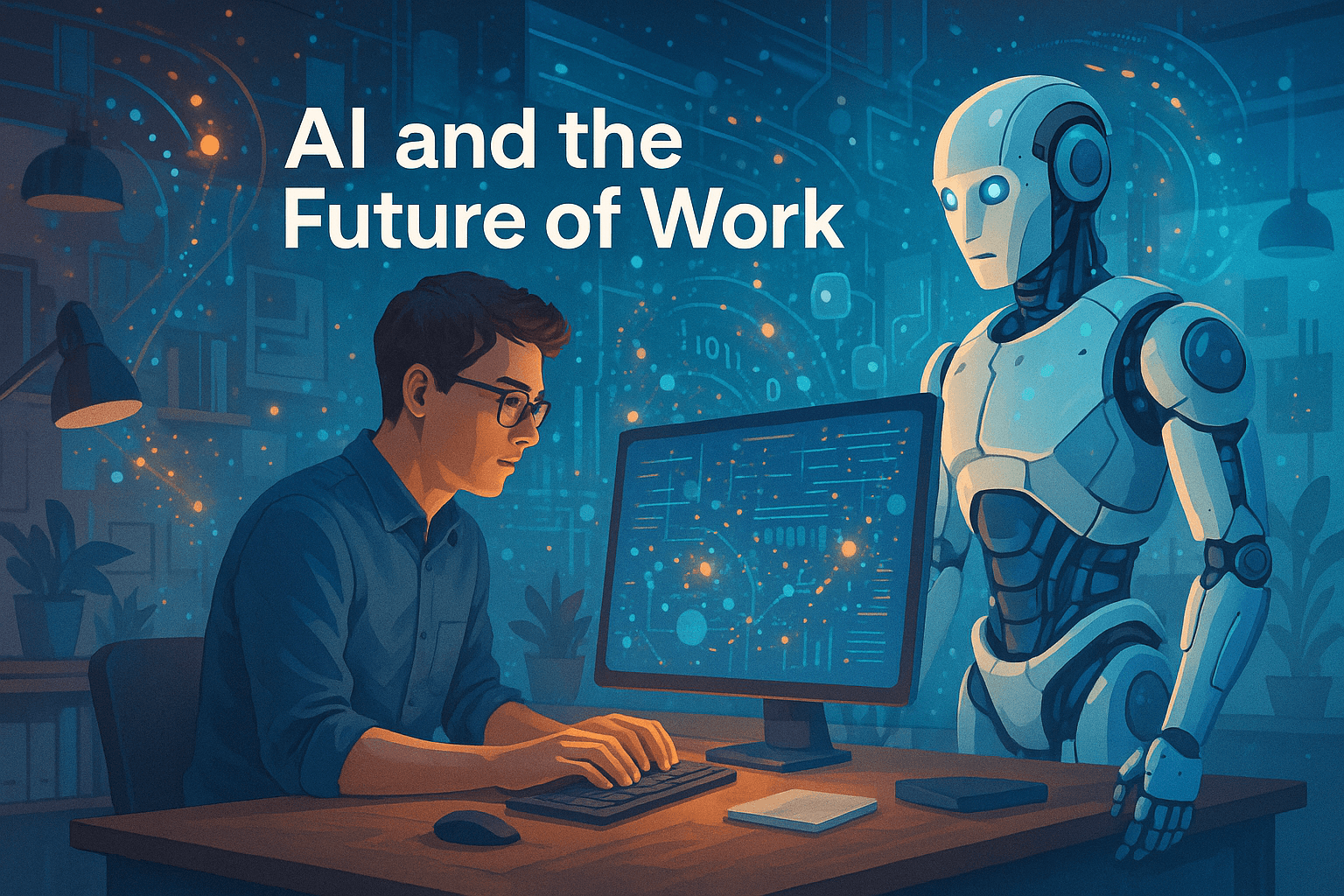
All images proudly brought to you by AI, approved by vibes.
AI’s not here to take over—it’s here to work with us! You can read my other article over on Hashnode (https://pkmanas22.hashnode.dev/). Let’s connect on Twitter or LinkedIn (I’m pkmanas22 everywhere) and share thoughts or questions. And if you enjoyed this piece, leave me a comment or give me a little love on Hashnode!